Tuesday, April 12, 2011

Reflection

When I read Jason's part, from the beginning it seemed that his letters would have a big significance later on in the story. I was correct when I predicted that Jason would somehow die in the end, and it is assumed that he did die because he has been missing for months with no trace. The letters Jason wrote were the more crucial than the letters that Cheryl, Heather and Reg wrote because Jason's revealed some truths in his life. Jason revealed that the twins were actually his twins and not Kent's; if he hadn't have written this note, no one ever would have known Barb's secret. I predicted that Jason would kill himself in the end, but it seems as though he actually just went missing and didn't survive in the wilderness.

When I was reading Heather's part, I had a feeling that Allison wouldn't be as good as she seemed. In the end we find out that Allison is a fake and completely manipulated Heather, so my gut instincts about psychics was correct.

As I was reading each person's perspective on Reg, knowing that he had his own chapter at the end, I figured that we see a softer side of Reg in the end. Reg was he bad guy throughout the whole book, and generally the bad characters turn good in the end, which is what happened in Reg's case.

From the critic article summaries I wrote about: “The novel begins to lose some of its narrative coherence [after Cheryl and Jason’s parts] and we cease to care as much about what happens after that." (Johnston 60)  After completing the novel, I agree with Johnston because Cheryl's part was what captivated my interest, and although I did enjoy the rest of the book, I found her part to be the best, and each perspective got slightly less interesting. Most of the action is from the school shooting part, which takes place in the first two perspectives of Cheryl and Jason, which may be why I found them more captivating then Heather and Reg, who were only indirectly related to those events.

At first, I thought the story revolved around Cheryl, but now after finishing the reading, I see that it actually revolves around Jason. Everything Cheryl did in her young life was for Jason: becoming religious, getting married. As we continue through perspectives, Heather's part completely revolves around Jason and their relationship, and in the last part of the book, Reg's part reflects on his life and the impact he had on his son Jason. In the beginning, Jason had everything he could have ever wanted, he found love in Cheryl.


After finishing reading, you see everything Jason went through and realize Jason's life was a tragedy. He had a hard life growing up with Reg, who was a religious freak. Then the love of his young life, Cheryl, tragically dies right in his arms after a school shooting, he resorts to drug trips for his thrills, and goes missing in the end and is presumably dead.

Picture from: http://tinyurl.com/6fegoy6

Book Note Summary: Part Four - Reg

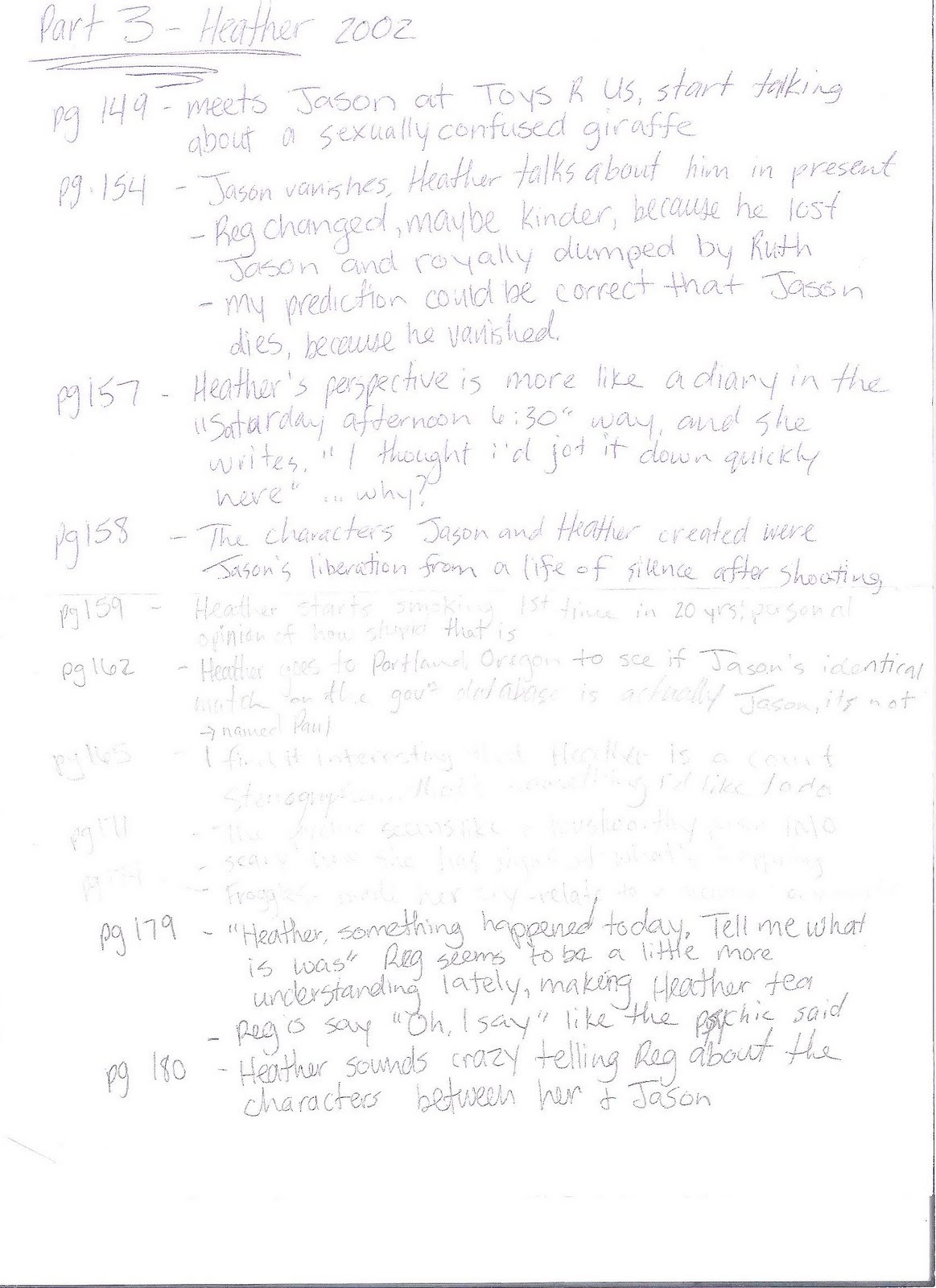
Book Note Summary: Part Three - Heather


Book Note Summary: Part Two - Jason

Book Note Summary: Part One - Cheryl

Exposure to pain

“Will you just tell me why it is that the only way we ever seem to take steps forward in life is through pain? Huh? Why is exposure to pain always supposed to make us better people?” (Coupland 181)

This quote stand out to me while I was reading because I think it represents the theme of the book. Every part of Hey Nostradamus! is dealing with some form of loss, some form of tragedy, some form of pain. Jason shed his religious ways into a new person after the death of Cheryl, Heather turned into a maniac after the loss of Jason, and after a lifetime of pain and loss in Reg’s life, he is finally able to be a better person and see what he has done wrong. Reg can now reflect on past decisions, question his motives, and be a gentler person, but he had to lose everything to become this person. I can relate to this quote because I’ve got through a particular moment of pain in my life, and I truly believe that I wouldn’t be the person I am today if I wasn’t bullied. I think that time in my life made me a stronger person and taught me how to deal with the pain caused by others.

Picture from: http://tinyurl.com/3o7zo6x

A new side of Reg


The fourth part of Hey Nostradamus! is from the perspective of Reg in 2003. Reg explains his actions, why he was the way he was starting from the early points of his life, and his reasoning with God. In Cheryl and Jason’s perspectives, we see a very negative side of Reg. We see the religious, controlling, evil side of Reg. When we get introduced to Heather’s part, she, combined with the loss of Jason, bring out a new side of Reg. We begin to see a heart behind the rough exterior. “Heather, something happened today. Tell me what it was” (Coupland 179) shows Reg to be a little more understanding lately, as he was making Heather tea. Also, when Heather tells Reg about the characters between her and Jason, Reg doesn’t react in his normal religious-freak-out sort of way; instead, he is more understanding and actually finds the use of characters to be a good output. It’s sad that it took the death of his son Kent, the royal dumping by his wife, and the loss of Jason for Reg to finally get Reg to see some error in his ways, but I guess better late than never. In the final part of the book, Reg is writing his note to Jason with the intention of posting up photocopies of it in the forest that Jason’s shirt and debit card are found in (as told to Reg by the RCMP). Reg provides us with one last sliver of hope that by putting up the posters, Jason will stumble upon one of them (although it is very likely that Jason is already dead).

Picture from: http://tinyurl.com/43vf5ox

Déjà Vu

“Usually a Déjà Vu, like happiness, vanishes the moment you recognize it...” (Coupland 217)

This line, as spoken by Heather, really stood out for me while I was reading. It made me think about how true that statement actually was. I experience Déjà Vu a lot, seemingly more than others, and I never noticed that the cause of it going away is whenever I actually recognized that it was happened. This quote got me thinking about if happiness, on the other hand, actually does vanish the moment you recognize it. I can think of certain times in my life where that did actually happen, and once you recognize that everything is going right in your life, you get thrown a curveball. Some challenges one has to overcome are harder than others, but the key to happiness is always being able to get over those speed bumps in life’s journey.

Picture from: http://tinyurl.com/3hs8lod

Psychic


At first, I thought Allison, the psychic, was a trustworthy person. I found it scary how she had a sign of what was happening to Jason. When Allison knew about Heather and Jason’s character Froggles, (Coupland 174) it made Heather cry. Although I had disbelief in other psychics, I thought that Allison was truly trying to help Heather. Instead, Allison was completely manipulating and abusing Heather’s emotions. She made Heather pay ridiculous amounts of money for services which turned out to be fake because Jason was the one who left the note for Allison to tell Heather should he ever disappear. The fact that Allison doesn’t answer her phone and no one knows of her made it seem like she didn’t actually exist at first. On page 194, Heather is being completely oblivious, stupid and crazy. The psychic told Heather she wasn’t a real psychic, yet Heather offers to pay for her car troubles and fee of $5000 (Coupland 194) because she is just so absolutely desperate for communication with Jason. On one hand, Heather deserved to be tricked because she was being so naive and gullible, but on the other hand, I think the author Douglas Coupland could have added some punishment for Allison being so sly and manipulative. It’s one thing to mess with one’s property and take Heather’s money, but Allison took it too far by playing around with her emotions when Heather had already gone through enough pain.

Picture from: http://tinyurl.com/3k8f8uu

Connections to my life

From the very beginning of the novel, I noticed interesting similarities and connections to my own life. When I first chose Hey Nostradamus! the only thing I knew about it was that it was about a school shooting. As I continued reading, I found other, rather strange, coincidences.

I have a friend, who I met in Biology class (which is also where Cheryl and Jason first met). This friend was in our school play, called “Lockdown”, which is about a school going into lockdown with a shooter in the building (which is exactly what happened in Hey Nostradamus!, a school shooting; a tragedy). It gets weirder from there. This same friend also works at Toys R Us (the same place that Jason meets his future girlfriend Heather).

Another connection I made was that Heather is a Court Stenographer. I am very interested in law and courtroom procedures, so I found it especially appealing that she had that job. I did a co-op placement at a law office last semester, and I found that I knew a small amount about Heather’s job as I was reading it which was beneficial.

Heather visits a psychic often to have "connection" with Jason. I have been to a psychic before, and as I was reading the psychic parts of the book, I was skeptical of Allison's (Heather's psychic) abilities. Knowing that Allison is a fake psychic makes me question if psychics even have any special abilities, or if I was just manipulated like Heather was. (side note: I was too young to remember half the things the psychic told me)

Picture 1: http://tinyurl.com/5r9qfs4
Picture 2: http://tinyurl.com/67mja6c
Picture 3: http://tinyurl.com/6e99h7k

A sexually confused giraffe


We are now introduced to Heather’s part of the book, who is the current girlfriend of Jason. Heather meets Jason at Toys R Us and they start talking about a sexually confused giraffe. Their relationship develops upon their ability to create a fantasy life out of imaginary characters they create in their minds. The creation of the characters liberated Jason from a life of silence after the shooting, because he detached himself from the world after that.
What is different about Heather’s perspective is that it is written more like a diary. She makes each entry like “Saturday afternoon 6:30” and she writes “I thought I’d jot down quickly here” (Coupland 157). I am still not sure why it is written so differently from the other perspectives, but I’m assuming it was the best way to switch it up and make it different from the other people.
The characters that Jason and Heather created not only were the basis of their relationship in the beginning, but also in the end. When Heather gets fooled by the psychic, it’s because she knows things that only her and Jason knew about the characters. Heather is completely manipulated because she is so desperate for a connection with the afterlife (which is likely where Jason is, since he is nowhere to be found). Jason and Heather both seem to be a little crazy because of their obsession with these characters. It could have been taken as a joke in the beginning, but knowing that they continued this for years just makes you question their sanity. Six year olds make up imaginary characters, not thirty-something’s.

Picture 1: http://tinyurl.com/5wwekwb

Viva Las Vegas

After the death of Jason’s brother Kent in a tragic car crash, the whole family is devastated. Before everyone finds out about the crash and death though, Barb (Kent’s husband, Jason’s sister-in-law) convinces Jason that she always wanted a child with Kent, but they were unsuccessful. Barb has the idea that if on the same day as Kent is killed, she and Jason have sex to pro-create, no one will ever suspect Kent is not the father. Barb’s worry is that people would begin to figure out that any further child she has isn’t Kent’s because it would be longer than 9 months since his death. Barb asks Jason to be the one to create a child with because of the similar genetics of Jason and his brother. No one would ever know that Barb’s child is not actually Kent’s, and that is the only thought that has consumed Barb’s mind at this point. In my mind, it does make sense that she would want one last thing to hold on to a memory of her husband Kent, but I personally think I would be grieving too much to even think about having sex with my husband’s brother, even with a plan like hers.

Starting on page 142, Barb and Jason make their way to Las Vegas because Jason only agrees to have sex with Barb if they are married first. In my mind, Jason gets a strange thrill out of getting married in the same church as Cheryl. Personally, I would never want to compare a second marriage to the first one, and I would do everything in my power to avoid the similarities, whereas Jason appears to be drawn to them.

After the wedding of Barb and Jason, they run into a mutual friend Rick Kozarek. Jason panics now Rick has seen the two together, but doesn’t immediately act upon his realization. Barb is the one that takes matters into her own hands without the knowledge of Jason. Barb kills Rick (Coupland 144) so that there was no possible way that they could blab about seeing Jason and Barb together and ruining their child plan. I must admit, I was absolutely shocked that Barb killed Rick. The events in that part just happen so fast that I barely even considered murder as an option, but then again, I wasn’t sure how else they were going to get themselves out of it. I’m amazed that Barb never got caught. She got away with murder.

Picture 1: http://tinyurl.com/4x2e5ur
Picture 2: http://tinyurl.com/3coz7vj

Update: No one ever finds out that Barb's children (who turn out to be twins) were Jason's, and not Kent's. In Reg's part of the novel, he discusses the remarkable resemblance between Jason and the twins (although Reg never specifically says that he is suspicious of Jason being the father). "And then last year [Jason] vanished, and all that remains are the twins - the spiting image of you, I might add." (Coupland 238) It isn't hard to believe that no one suspects Jason to be the father, but in reality, why on Earth would he be? It's not like Barb and Jason actually had feelings for eachother to be together, their soul intention was a child for Barb. Any resemblance relating to Jason would just be connected to his brother Kent.

The Real Nostradamus

Jason’s mother tried to find the massacre as it was foretold in the prophecies of Nostradamus:
Hey Nostradamus! Did you predict that once we found the Promised Land we’d all start offing each other? And did you predict that once we found the Promised Land, it would be the final Promised Land, and there’d never be another one again? And if you were such a good clairvoyant, why didn’t you just write things straight out? What’s with all the stupid rhyming quatrains? Thanks for nothing." (Coupland 91-2)

This is the first and only time in the novel that Nostradamus is mentioned. As I was reading the book, I always questioned what the significance of the title was. Upon further research, I heard that Nostradamus made predictions of the future, and based on the context of the quote above, he must have had some foretelling of a shooting.

This photo is of one of Nostradamus’ prophecies: 2012. Only time will tell if this prediction has any truth to it.

The River (Part 2)

As I was reading Jason’s drug trip stories and the events that happened in the river, I was reminded of a song by my favourite singer. LIGHTS has a song called “River” that I find reflects some points of the novel. Here are the lyrics:
Out across cities I see buildings turn into piles
and watch the world in wonder, as mountains turn into tiles
and trees losing their leaves and their faces becoming tired
i wish i could discover something that doesn't expire
come stumble me

take me river, carry me far
lead me river, like a mother
take me over to some other unknown
put me in the undertow

such other things that make a kingdom rumble and shatter
the same dynamic that another day would never matter
it really just depends on who's giving and who's receiving
and things that don't make sense are always a little deceiving
come and humble me

take me river, carry me far
lead me river, like a mother
take me over to some other unknown
put me in the undertow

i wanna go where you're going
a follower, following
changing, but never changed
claiming, but never claimed

take me river, carry me far
lead me river, like a mother
take me over to some other unknown
put me in the undertow

take me river, carry me far
lead me river, like a mother
take me over to some other unknown
put me in the undertow


I find that the “Take me river, carry me far” represents Jason’s journey. Throughout his trip with Yorgo, we see more of Jason’s personality. We learn that Jason is too kind hearted to commit the murder of Yorgo. The river carrying him is like his journey of learning; the “Put me in the undertow” part is like where Jason leaves Yorgo. He leaves him in the middle of the river, but he calls for help for him. Although he doesn’t physically help Yorgo, his conscious tells him he should do something and call someone for Yorgo. In the song: “I wish I could discover something that doesn’t expire” everything in Jason’s life has expired. Cheryl expired in the most literal form when she died. Jason’s religious beliefs expired after the massacre because “God is how you deal with everything that’s out of your own control” (Coupland 52) and he realized that if God was truly watching over him, he would have prevented the slaying of his wife.

Link to listen to “River” by LIGHTS: http://www.youtube.com/watch?v=t4Do_DXFHdY&feature=related

The River

“The river looked cold, and was filled with rocks like the one I’d used to kill Mitchell.” (Coupland 124)

When I was reading the part when Jason is describing the river he was in when Yorgo got stuck, I pictured a river like this. Nothing too rapid, but dangerous enough that their lives would be threatened. As well, this picture is actually from Vancouver, where the story takes place. The rocks by the river in this picture are large enough that they could actually have killed Yorgo if Jason had thrown the rock at him. “I lunged for a river rock and then – time folded over in a Moebius strip – I was once again in the school cafeteria, and there was Mitchell’s head, but it was now Yorgo’s head, and in my hand was a rock and – suddenly I had the option of murdering again.” (Coupland 125) I always had a feeling that Jason would never actually kill Yorgo. I feel as though Jason has a good soul, and that he wouldn’t have even killed Mitchell if it wasn’t a life or death situation.

Also, at the time of being in the river with Yorgo, Jason was on a drug trip. In my opinion, he definitely turned to drugs because of the tragedy he had been through. Not only did he witness a gruesome massacre of his wife and classmates, but he faced tragedy within his own family by not even having a relationship with his father. Jason and Reg both pushed each other away, which had an effect on both their personalities, resulting in loneliness.
Picture 1: http://tinyurl.com/3n2blpt
Picture 2: http://tinyurl.com/3njwzro

Saturday, March 19, 2011

GOD IS NOWHERE / GOD IS NOW HERE

If there were a sentence that could sum up Hey Nostradamus! it would be the writing  Cheryl did on her binder before her death. Her repetition of “GOD IS NOWHERE / GOD IS NOW HERE” (Coupland 9) is centered around the theme of religion, and how each character in the book feels differently about it.

In Cheryl’s eyes, this picture would read “GOD IS NOW HERE”. Her religious nature first came as her attempt to win Jason’s heart, but soon her life was indulged with all things God and truly believed in religion as opposed to the beginning stages of her fascination. Her life with Jason revolved around their religious beliefs, but Jason began only being this religious for the love of Cheryl and because of the impression his religious father Reg left on him, not his own opinions. In Jason’s eyes, this picture would read “GOD IS NOWHERE” because the more Reg pushed religion on him, the more he rejected it. The final breaking point of Jason’s questions for religion came when God was nowhere is be seen in the school massacre. He realized that no matter how much he prayed, God wasn’t going to save his classmates, his own actions were. By God taking away Jason’s wife Cheryl, he lost all hope, and in some ways, Jason would have been better off dying in the school shooting than surviving it. If Jason was also shot, he would be free from all his thoughts of depression, guilt and anger. Jason has such hard feelings that God was not there to prevent the school shooting that he says “…if you had seen me, I sure wouldn’t have been praying.” (Coupland 45) After being a part of such a tragedy, unfortunately Jason’s life will always be consumed with thoughts of it: “He never really got over it, you know” (Coupland 47)

Predictions and Foreshadowing

As the book progresses, I find more events are being foreshadowed. Starting with the school massacre, an alarming hint that a student was possible of such a horrendous shooting could have come from Mitchell’s science project. One of the three shooters, Mitchell Van Water showed early signs of a twisted mind in his school science fair labeled “Getting the most bang for your buck.” (Coupland 24) The three shooters had other warning signs but of course their social awkwardness and bang for your buck quirkiness wasn’t obvious until it was too late. The way the story is written from each prospective is the present reflecting on past events. By retelling past events, the reader catches on that these are all leading up to some big event. Cheryl talking in the past tense about the events leading up to something, you begin to realize that some sort of tragedy to end her happiness is about to happen. So far, the foreshadowing in Jason’s part seems to be that all his past events involving drug abuse and the death of Kent are leading up to something tragic happening to Jason. The fact that Jason is writing these diaries to his nephews makes you wonder why he would even tell most of his life story to anyone, especially his nephews. I have a sense that Jason will die some time before the end of his part in the book, but all his truths will be revealed in the letters to his nephews that will bring some peace and closure to the family. All of Jason’s drug blackouts could be foreshadowing towards his death, considering I don’t think he would commit suicide if he has already lived so long with suffering.

I imagine that Jason’s collection of letters to his nephews would start to pile up like this picture. I predict that his letters will have a huge significance later in the book, maybe when Jason or another family member dies, and the truth of his life can be revealed and have closure.

Thursday, March 17, 2011

Perspectives through Prayers

The way Hey Nostradamus! is presented is through different perspectives. The book is divided into four parts: Cheryl, Jason, Heather and Reg. Each part tells the first hand experience they had relating to the shooting, whether they were directly or indirectly involved. The structure also varies throughout the reading because each paragraph that is divided by “* * *” is a break between thoughts, usually a flashback between past and present. As the shooting is happening during Cheryl’s part, there are also different perspectives represented in the form of other people’s prayers. After reading a few paragraphs that each start with a different salutation like “Dear God”, “Lord” and “Dear Lord”, the reader realizes that these are no longer just the prayers of Cheryl, but those of the other people in the room. These prayers show each perspective on the situation, most through panic and confusion as to why this shooting is happening and how God is not saving them.

I included this picture because I feel like it represents the questions that the Delbrook school students were asking God in their prayers during the shooting. They want to know how God could sit by and let such an awful thing happen. Maybe God stepping in to interfere was when Jason threw the rock at Mitchell, simultaneously ending the killing spree. Also, this picture relates to Hey Nostradamus! because the book is roughly based on the Columbine school shooting and the name on the school in this picture is Columbine High School.

This picture reflects how so many people would have been praying to God during the school shooting. Their prayers are portrayed in Cheryl’s part of the book while they’re being shot at in the cafeteria and not only are other students praying, but the parents and rest of the community are. I feel like this picture shows everyone coming together in a time of need to pray for the events that were unfolding.   

Picture #1 from: http://tinyurl.com/74j28ur

Wednesday, March 16, 2011

Afterlife

In the first part of the book, Cheryl is describing the events of the school shooting. The more we find out, the more we question whether she is alive or dead while telling this. “Cheryl – the pretty girl who was the last one to be shot” (Coupland 25) makes it seem as though Cheryl is telling the story from the afterlife, which makes the reader question if she’s in heaven, or stuck in a state of being neither alive nor dead.

I included this picture because I think it illustrates where Cheryl currently is. It seems she is in an in-between location writing her side of the story, somewhere in the middle of this pathway to heaven. She has not yet reached heaven where she would have no interaction with Earth, so in a half state makes the most sense to me. Also, because Cheryl fully accepted God, she accepted her death. Her religious nature made her think the best of the situation, so I also find that in Cheryl’s mind her death would have looked more like this picture, with a beach and brightness rather than the dark reality of her gruesome death.

Friday, March 4, 2011

Critical Article Summaries

Critical Article Summary #1
A book review done by Jeff Zaleski of Publishers Weekly introduces Hey Nostradamus! author Douglas Coupland’s writing styles and common genres to his work. Zaleski recognizes Hey Nostradamus! as having a familiar template of “sardonic humor and sharp cultural observation” (Zaleski 193) relating to his other books, but what makes this story different from his others is that it is narrated through four perspectives. Varying perspectives make “[Coupland’s] lack of narrative control...particularly evident....” (Zaleski 193) Previous fans of Coupland’s work are more likely to enjoy Hey Nostradamus! than those who have not yet entered “Coupland-world”. (Zaleski 193) The beginning of the story is promising with Cheryl’s side of the story being told, but “the novel unravels when Jason reappears...” (Zaleski 193) in Part Two 1999: Jason.
Zaleski, Jeff. "EBSCOhost: Hey Nostradamus." Hey Nostradamus! Book Review 250.18 (2003): 193. Web. 3 Mar 2011. <http://web.ebscohost.com/ehost/detail?hid=21&sid=2b58348b-c195-4a29-a4a6-104b2fdfb3f0%40sessionmgr12&vid=4&bdata=JnNpdGU9ZWhvc3QtbGl2ZQ%3d%3d#db=ehh&AN=9685162>.

Critical Article Summary #2
(pictured: Columbine school shooting)Hey Nostradamus! has a fictional plot centered around a school massacre which is similar to the Columbine school shooting. Coupland presents this plot in two ways: one looks at it in a quirky and dark humorous way, and the other slightly more haunting, referring to the graphic nature of a massacre. (Johnston 60) Adding to the eeriness of the school shooting, Cheryl leaves a legacy, centered on the mysterious coincidence of her notebook scribble “God is nowhere God is now here” (Coupland 9) written before the shooting. Coupland’s dark humour approach to a story surrounding a school shooting is only partly successful because the grip and
excitement of the first two parts of the story (Cheryl and Jason) falls apart leading into the parts involving Heather and Reg. “The novel begins to lose some of its narrative coherence [after Cheryl and Jason’s parts]” and we cease to care as much about what happens after that. (Johnston 60) Despite the confusion and lack of interest that switching perspectives from Cheryl and Jason creates, the story has its fascinating points and will be most enjoyed by fans of Coupland’s novels. (Johnston 60)
Johnston, Ingrid. "Document Page: Hey Nostradamus." eLibrary Hey Nostradamus 10.1 (2004): 60. Web. 5 Mar 2011. <http://elibrary.bigchalk.com/elibweb/curriculumca/do/document?set=search&dictionaryClick=&secondaryNav=&groupid=1&requestid=lib_canada&resultid=2&edition=&ts=CE1E263A780DAB0CB32288B775E68936_1299363985334&start=1&publicationId=&urn=urn%3Abigchalk%3AUS%3BBCLib%3Bdocument%3B120180868#citation>.

Critical Article Summary #3
The beginning of the novel starts in a charming way, with the perspective of the school shooting through the narration of Cheryl. Most of the best highlights of the book come from Part One: Cheryl, and declines in interest as the story progresses through the stories of Jason, Heather and Reg. “The use of multiple first-person narrators ill befits the sketchily similar characters...” and poorly reflects Coupland’s usual brand of pop culture commentary. (Wright 123) Hey Nostradamus! lacks the enjoyment of some of Coupland’s earlier works, including Generation X and Shampoo Planet. Wright recommends that fans should move on to new authors because Coupland’s more recent works like Hey Nostradamus! do not compare to his greater, earlier works. (Wright 123)
            Wright, David. "Library Journal: Hey Nostradamus." EBSCOhost 128.9 (2003): 123. Web. 3 Mar 2011. <http://web.ebscohost.com/ehost/detail?hid=21&sid=2b58348b-c195-4a29-a4a6-104b2fdfb3f0%40sessionmgr12&vid=4&bdata=JnNpdGU9ZWhvc3QtbGl2ZQ%3d%3d#db=ehh&AN=9740846>.

A common theme among these critical articles is that Coupland lost his narrative coherence by transitioning through new perspectives. A fascinating part came when the story spread across 15 years following the school shooting, so the reader could see how humans react to tragedy and how long something so devastating can affect you. Among the three authors of the articles, it is a common belief that Coupland’s earlier works were better than Hey Nostradamus! and that diehard Coupland fans will be the main readers of his newer works.